| Please Wait Loading ..... |
 |
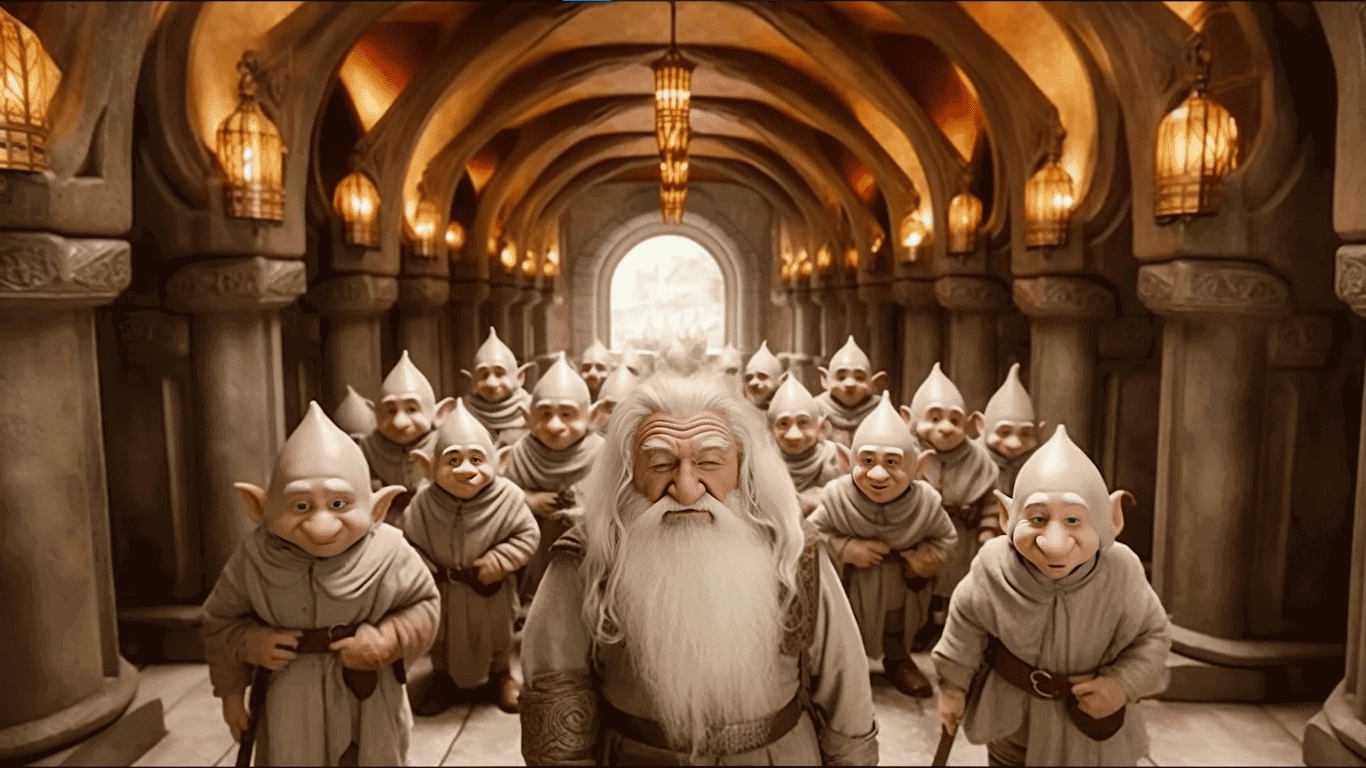
In recent years, artificial intelligence (AI) has revolutionized the film industry, transforming the way movies are made and viewed. One of the most exciting developments in this area is the use of AI to create new and innovative interpretations of classic films. In this article, we explore how AI has been used to turn the epic Lord of the Rings movies into a whimsical Wes Anderson-style film.
Artificial intelligence refers to the use of computer systems to perform tasks that would normally require human intelligence, such as perception, reasoning, learning, and decision-making. Machine learning is a type of AI that involves training algorithms to make predictions or decisions based on data.
The Lord of the Rings is a trilogy of epic fantasy films directed by Peter Jackson and based on the novels of J.R.R. Tolkien. The movies were released between 2001 and 2003 and were a critical and commercial success, winning numerous awards and grossing over $2.9 billion worldwide.
Wes Anderson is a highly acclaimed American filmmaker known for his distinctive visual style and quirky characters. Some of his most popular movies include The Royal Tenenbaums, Moonrise Kingdom, and The Grand Budapest Hotel.
AI has the potential to transform the film industry in numerous ways. For example, it can be used to automate mundane tasks such as color grading and sound mixing, freeing up filmmakers to focus on more creative aspects of the production process. It can also be used to analyze audience data and make more informed decisions about what types of movies to produce.
AI is already being used in various ways in the film industry, from virtual cinematography and animation to script analysis and production scheduling. In the future, AI could be used to create entirely new types of movies that are personalized to individual viewers.
A team of researchers at the University of California, San Diego used machine learning algorithms to analyze the visual and auditory features of the Lord of the Rings movies. They then used this data to generate a new version of the film that mimicked the visual style of Wes Anderson.
The resulting film, titled "The Fellowship of the Ring: A Wes Anderson Interpretation," features pastel colors, symmetrical framing, and whimsical music. The characters are portrayed as quirky and idiosyncratic, with exaggerated facial expressions and unusual speech patterns.

One of the main advantages of AI in filmmaking is its ability to automate repetitive tasks and streamline the production process. This can help to reduce costs and increase efficiency. However, there are also concerns that AI could replace human creativity and lead to a homogenization of movies, as algorithms are used to create movies that conform to certain patterns or audience preferences.
Another disadvantage of AI in filmmaking is the potential for bias. Machine learning algorithms are only as good as the data they are trained on, and if the data is biased, the algorithm will be too. This can lead to perpetuating stereotypes and discrimination.
The question of whether machines can truly be creative is a contentious one. Some argue that creativity is a uniquely human trait, involving a combination of imagination, intuition, and emotional intelligence. Others argue that creativity is simply a matter of generating new and novel ideas, which machines are capable of doing.
Ultimately, the answer may depend on how we define creativity. If we view creativity as simply the ability to generate new ideas, then machines are certainly capable of being creative. However, if we view creativity as a more complex process that involves emotional and intuitive elements, then it may be more difficult for machines to truly be creative.
While AI can automate certain aspects of filmmaking, such as editing and sound mixing, it is important to remember that humans still play a vital role in the process. Filmmaking is a highly collaborative endeavor, involving a range of creative professionals such as writers, directors, actors, and cinematographers. AI can assist in the process, but it cannot replace the human touch.
As with any technology, there are ethical considerations that need to be taken into account when using AI in filmmaking. For example, there is a risk that AI-generated content could be used to spread propaganda or misinformation. There is also a risk that AI-generated content could be used to perpetuate harmful stereotypes or biases.
To address these concerns, it is important to ensure that AI is used in an ethical and responsible manner. This may involve implementing safeguards such as data privacy protections, bias detection and mitigation tools, and ethical review processes.
As AI continues to evolve and become more sophisticated, it is likely to play an increasingly important role in the future of storytelling. AI has the potential to create entirely new forms of narrative, such as interactive and personalized stories that adapt to individual viewers.
However, it is important to remember that storytelling is ultimately a human endeavor, and AI can only assist in the process. The best stories will always be those that are created by humans, who are able to draw on their own experiences, emotions, and imagination to craft compelling narratives.
The use of AI to turn the Lord of the Rings movies into a Wes Anderson-style film is just one example of the many ways in which AI is transforming the film industry. While AI has the potential to automate certain aspects of filmmaking and create new and innovative forms of storytelling, it is important to ensure that it is used in an ethical and responsible manner. Ultimately, the best movies will always be those that are created by human creativity and imagination.
